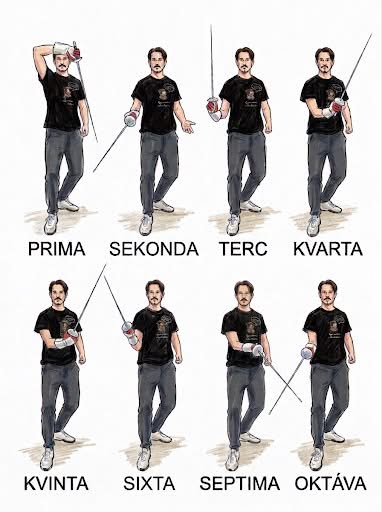
Sport fencing has 8 basic positions. In English they usually go by their French names: prime, seconde, tierce, quarte, quinte, sixte, septime and octave. In Czech they are named after the classes of the eight-year grammar school, from prima to oktáva. The terminology comes from Italian and, unlike in countries further east of Slovakia, Czech fencers surprisingly never translated it, even though many other fencing terms of Italian origin did get Czech equivalents.
Positions of the weapon are the cornerstone of technique. We can use them both in attack and in defence, to engage the opponent's blade or to beat it away. A position can also serve as a parry that deflects the opponent's blade and protects us. In short, if you are starting to work with a weapon, whether in sport fencing or in stage fencing, it pays to know and master these 8 positions.
A dash of history
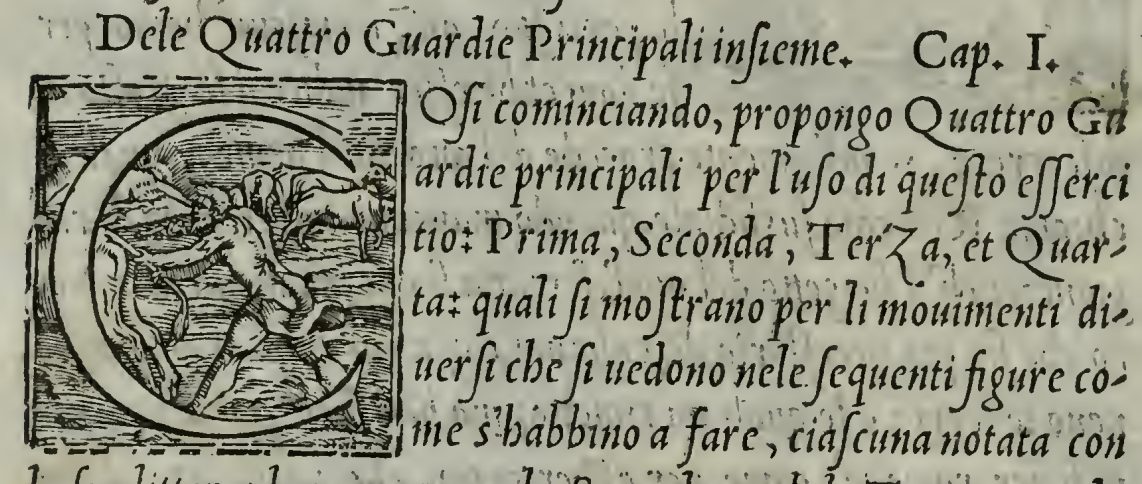
Tradition has it that sport fencing got its foundations in 16th-century Italy, where the masters of the time defined four basic guards, that is, positions not only of the arm but of the whole body.
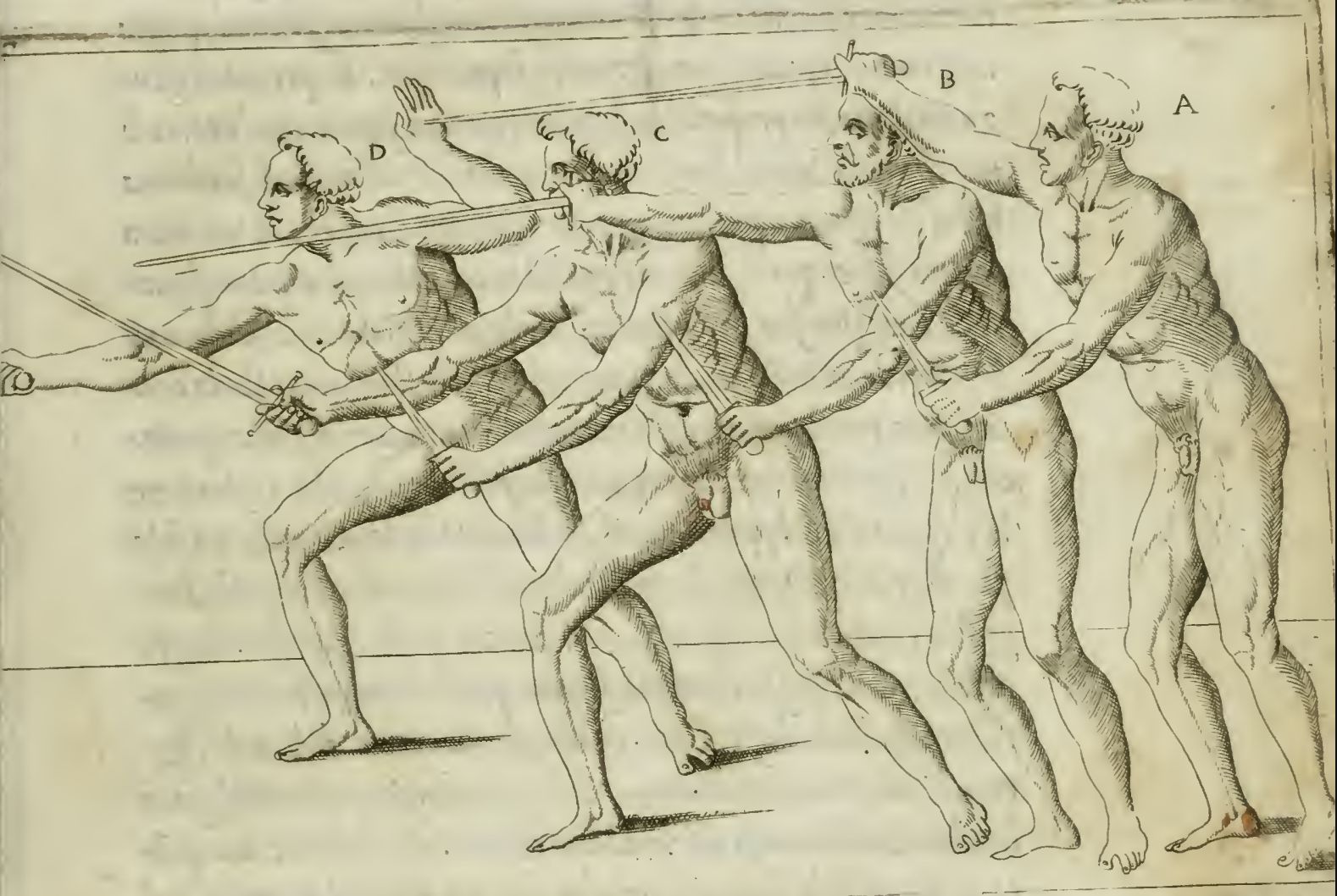
Later French masters added more positions to these four and so completed our full set. Over time, various masters in various places also spoke of further positions, such as cercle or nona. The truth remains, however, that these extra positions were often just small variations of the basic eight.
The eight positions
The basic positions lie in four quadrants in front of the fencer's body:
- high inside – in front of the chest and belly,
- high outside – in front of the shoulder and back,
- low inside – in front of the groin,
- low outside – in front of the front leg.
Each of the eight positions lies in one of these quadrants, only prime reaches into both inside ones.
Now for the definitions (Czech names in brackets):
- Prime (prima) – high and low inside, hand in pronation, the point aims down and the fist is roughly at shoulder height. Protects the chest and the groin.
- Seconde (sekonda) – low outside, hand in pronation, the point aims down. Protects the front thigh.
- Tierce (tercie) – high outside, hand in pronation, the point aims up. Protects the shoulder and back.
- Quarte (kvarta) – high inside, hand in pronation, the point aims up. Protects the chest.
- Quinte (kvinta) – high inside, hand in supination, the point aims up. Protects the chest.
- Sixte (sixta) – high outside, hand in supination, the point aims up. Protects the shoulder and back.
- Septime (septima) – low inside, hand in supination, the point aims down. Protects the groin.
- Octave (oktáva) – low outside, hand in supination, the point aims down. Protects the front thigh.
You can see the individual positions in the picture:
Quarte beat, sixte parry: the bestsellers of sport fencing
As mentioned in the introduction, positions can be used in all sorts of ways. Some of them, however, are especially effective in certain actions.
The biggest bestseller is probably quarte. The on-guard position is very close to sixte, so it is usually the chest that is left open. Quarte is then used to defend this open target. Quarte is also very handy for beating the opponent's blade. In Czech fencing halls you will hear the original Italian word for a beat, battuta, too.
May this short text serve you well, and know that fencing skill is honed not so much by theoretical musings as by repetition in the fencing hall.
Sources
- Camillo Agrippa: Trattato di scientia d'arme, Italy, 1553.